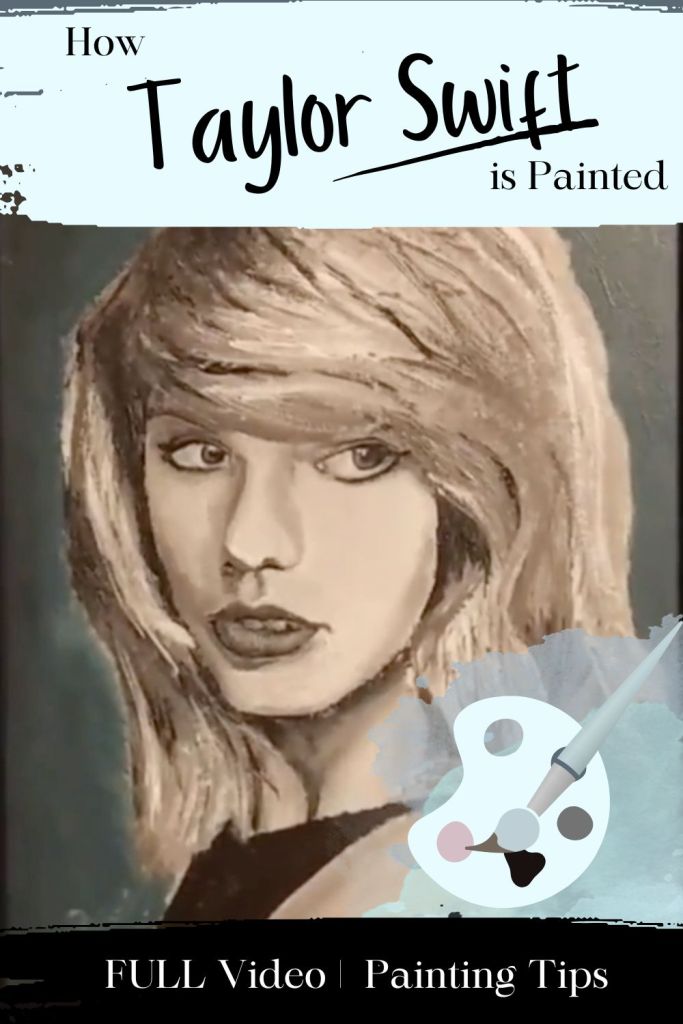
Now, yes, we all know who the great T Swift is… but, do you know how her portrait is painted?
Because, get ready, you’re about to learn exactly how her face is “made” in paints. And, whether you’re an artist yourself or not, there’s a lot we can learn from the beautiful Miss Swift in terms of painting.
Now, for those of you who I may not have met yet… hey there; I’m Kari Lynn M., a professional artist who loves to paint! I also happen to love talking about painting… which is why I’m here and ready to show you exactly how I go about painting Taylor Swift’s portrait in the video below!
Plus, if you’re a fellow artist yourself, stay tuned to the end of the video, then scroll down to hear more about how you can learn to paint portraits just like this one. Because, listen… it’s totally not nearly as hard as you think, even if you’re a beginning painter. It’s all just about “breaking things up” into simple steps, which I walk you through in the full video.
Now, as promised, here’s some more info & tips when it comes to painting someone’s face, whether it’s Taylor’s or, you know, maybe your own!
Tips for Painting Anyone’s Portrait
1. Use Your Reference Photo
As I mention in the video above, I always, always, ALWAYS use a reference photo when doing just about any painting. For portraits, though, it’s even more crucial. Because… long gone are the camera-less days of ye olde when people had to sit for 56 hours to have their portrait painted.
Using a reference photo, especially for beginners, is important because photos don’t move or change. And, if you really are adamant of doing things the old fashioned way with sit-down portraits… well, save that for later, and get some practice working off of photos first. Because you can best understand how light hits a subject in a photograph.
I also recommend using a reference photo to keep your portraits as realistic as possible. And, as the name implies—you have to reference that photo constantly. Check it every time you move from one area of your painting to the next, and use the photo as your “answer” to any and all questions you may have about your portrait. For example, if you don’t know quite where the highlights in your eyes need to be… “ask” your reference photo, and study where the light is in the eyes of the photo.
2. Start in Grayscale
Again, I mention this in the video talk-through, but I highly recommend beginning painters start doing portraits in black-and-white.
This is because, with a portrait in grayscale, you have far fewer colors to worry about. And, as we all know, people in our portraits can have so many different colors when it comes to hair, skin, eyes, clothes, etc. However, with a portrait in black-and-white… you only have a few variations of black, white, and gray to worry about.
By using grayscale paints, you can focus on practicing the highlighting and lowlighting in your portrait—not mixing colors over and over again until you get them right.
And, as an added tip here… use raw umber instead of black paint. Again, I said it in the video, but I’ll say it again, because black can turn blue sometimes when lightened up. With raw umber, you won’t have that problem, and raw umber is dark enough to resemble black in your painting (plus you can add some blue to it to make black as needed).
3. Focus on One Feature at a Time, in Order of Detail
Well, this may sound confusing, but another tip I have for beginners when it comes to portrait paintings is to focus on one facial feature at a time, and focus on each feature in order of “most complicated” to “least complicated.”
Basically, I’m trying to say that it’s best to work on the hardest parts first. Which, yes, can be quite intimidating… but, it’s better to put all your focus on the details before you fill in the larger areas. Or, at least, that’s my personal opinion—but I find that it works well!
So, for example, I like to work on parts of a portrait like this: eyes first, mouth second, nose third, then the rest of the facial skin.
Of course, each portrait is different, so you don’t have to stick to that order like it’s the ten commandments. However, that’s the order I typically stick to, and I recommend all beginners try it, too, so that they don’t feel overwhelmed by a blank canvas staring them down!
4. Try Learning with a Beginner-Oriented Painting Course
Now, as I’m sure you noticed me mention in the video above, you can totally learn how to paint portraits, just like Taylor’s, with an online painting course for beginners!
I offer a beginner-friendly painting course that will help you figure out how to make portraits with step-by-step videos, downloadable guides, and so much more. It’s all part of the “How to Paint a Portrait for Beginners Course”, available right now on my Canvas Academy learning platform!
To learn more, just click the button below, or watch the additional video below that for even more info.
Because we all know how difficult it seems to paint someone’s portrait… however, once you break things down into steps and tackle them one at a time, it suddenly becomes so much easer. Which is exactly what we do in the “How to Paint Portraits” course—we take tiny steps, one by one, that all culminate into painting full scale portraits, just like the one of T Swift!
So, to get started with the painting course, all you’ll need to do is join Canvas Academy with a monthly membership. And, don’t worry—our prices are way less expensive than some other online learning platforms!
In addition to the “How to Paint Portraits” course, you’ll also get access to hundreds of hours of other painting courses and classes on Canvas Academy. So, you can learn to paint everything from flowers and still-lifes to landscapes and more!
You can also click below to tour any of our other popular painting courses.




Now, I hope to paint with you all very soon, fellow Swifties!
–Kari
 Kari Lynn M.