Anybody else ever feel that certain tinge of jealously when you look at another artist’s painting, sigh, and think, “ugh, if only I could be that talented…”
Listen—you’re not alone. And, listen to this—there is definitely a way to become just as great a painter as the artist next to you without having so-called “talent”.
Now, there’s a couple of moving parts to making yourself a better artist, but I want to clear this up right here, right now: there’s really no such thing as “natural talent” when it comes to painting—that is, no one just picks up a brush and creates the Mona Lisa in one go. It literally just doesn’t work like that!
Instead, there are a few key things that many great artists, past and present, do or have done to become what we might perceive as “talented”. And, actually, these are things that anyone—including you—can do!
Trick #1: Understanding Color Theory
If you’re not already acquainted with color theory, you’re in for a big surprise. Because, of course, nearly all great painters know and utilize color theory in every piece of art they create… and, here’s the surprising bit… color theory is not based in art; it’s actually based in science.
Now, don’t get scared of the word science, okay! Color theory being rooted in science is actually a good thing because, just like any other topic of science, it can be studied, learned, and implemented by anybody. Plus, you don’t even need any fancy equipment or tools (like a telescope, or something like that) to learn it.
So… what is color theory?
Color theory, in short, is the scientific study and reasoning of how colors work. In terms of painting, it’s all about figuring out what happens, or should happen, when two or more colors are mixed together.
If you know color theory, you know that blue and yellow mixed together makes green. Or, with more advanced thinking in color theory, you’ll know that red and green mixed together creates a neutralized tone.
Want to start learning about the basics of color theory? Try taking a free color theory workshop online!
Learning about color theory allows you to better understand how the colors of the world around us can be applied to a piece of art in paint. It’s knowledge that will help you figure out how to get that perfect hue of blue in a mountain landscape or the right skin tone in a portrait painting.
Trick #2: Knowing Value
Another super-duper important concept to grasp within the realm of painting is the idea of value. And, no, we’re not referring to how much a painting by Picasso might be worth!
Value, in art, refers to how light or dark something (for example, an object in a painting) is. It’s all about knowing how light hits objects in real life so that light can be portrayed realistically in paintings.
A lot of times, value can be expressed in what we call “highlights” and “lowlights/shadows”. Think about it like this: if you were to hold a ball up to a light, like a lamp, would the ball appear to be one flat color? Probably not—it would appear lightest where the light seemingly “hits” or reflects off of the ball, and it would appear darkest where the light is unable to “hit” the ball, probably on the underside.

Using value can turn a circle into a sphere, just like that!
There’s a lot to learning value in art. That’s why I also recommend reading this article here to further understand the concept!
Trick #3: Grasping the Nature of Paint
Knowing how to control your paint is, if you already know the other stuff above, the thing that’s going to take you from a good artist to an amazing one.
Working with paint is drastically different than working with any other medium of art, be it graphite, charcoal, pastels, and so on. Paint is a wet medium, so it has to be worked with and applied in a wet state, and it often changes and shifts as it dries (for example, colors may change). The type of paint you use can make a huge difference in a painting, too, whether it’s acrylic, watercolor, oil, or tempera.
Another thing to consider is how you physically work with paint—think of how you hold and use your brushes, let alone what brushes you use. By using a brush well, you can create great texture in your art pieces, which is one of the key elements of art.
So, if you haven’t noticed by now, there’s actually a lot of technique involved in painting. There are certain methods to making certain textures, highlights and lowlights, or colors for your paintings; all it takes to up your painting game is learning about them (and, again, not talent!).
Trick #4: Practicing, Practicing… and Practicing
Now, y’all probably saw this one coming… but, listen, the expression “practice makes perfect” exists for a reason!
99.999999% of the artists you see creating beautiful pieces of art probably didn’t start out making beautiful pieces of art when they were, like, three years old. Instead, they got to where they are because they practiced making art.
So, putting what you know about things like color theory, value, and the nature of paint itself into practice is only going to make you a better, stronger artist. Plus, there are countless studies out there proving that, the more you practice or use something you’ve learned, the better you’ll know and remember it.
But, I get it—sometimes, it’s difficult to motivate ourselves to put in the work and physically do the practice. That’s why I’ve created an online painting platform for artists just like you, called Canvas Academy!
Canvas Academy is home to hundreds of hours of painting courses and classes, all here to help you learn everything from basic painting techniques (like we’ve discussed above) to how to paint gorgeous landscapes, still-lifes, portraits, and more. There are tons of free and premium classes available, all ready for you to explore.
Check out Canvas Academy now!
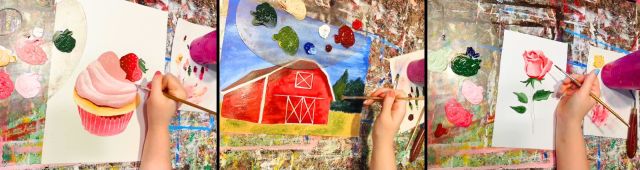
And, as always, remember that there’s no such thing as “natural talent” when it comes to painting. All good artists have worked hard to achieve the level of work they’re able to do, and it doesn’t come easy.
Now, let’s paint.
–Kari
 Kari Lynn M.