Hey there, fellow artist!
Know what a fan brush is? You know, the one paintbrush in your arsenal that is, likely, the least touched and used?
Well, whether you’ve ever picked up and used that one brush with the fan-shaped bristles you got in that beginner painting kit years ago or not… let’s show you how to actually use it. Because, really, the fan brush is so underrated, and you can do more with it in your future paintings that you may think.
Check out the video below to see the top 5 things you can use a fan brush for, or scroll down to read more.
Video: 5 Ways to Use That Fan Brush
1. Animal Whiskers
Fan brushes are actually really great for making whiskers on animals in paintings because, well, the bristles on the brush are already kind of shaped like whiskers!
To make whiskers with your brush, start from either side of the animal’s nose area with black, gray, or white paint (depending on the dominate color of the animal’s fur, you’ll want to choose a whisker color that pops best against the background). Drag the brush lightly toward the edges of the animal’s face, allowing the brush to splay out as you do so.
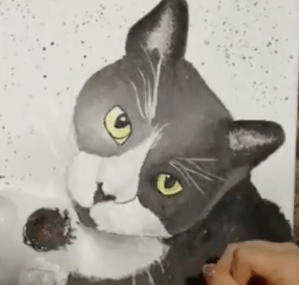
You can repeat this process around the animal’s brow area, too, for extra whiskers. This will help you give the animal a realistic quality with facial details.
2. All Types of Trees
Trees are found in, literally, all types of landscapes—from beach scenes to forests to even some cityscapes. And, no matter what types of tree you want to create, using a fan brush can actually help you get some fine details added into them.
To start, create a solid base for your tree in any desired color (the easiest way to create quick trees is to make them fully black, as if the light is casting a shadow on them). From there, use the fan brush to “wisp” thin lines into the shapes of branches and leaves. The wisping motion, or gently flicking the brush against the page or canvas, helps to leave delicate lines behind, avoiding the heavy globs you may get with other brushes.
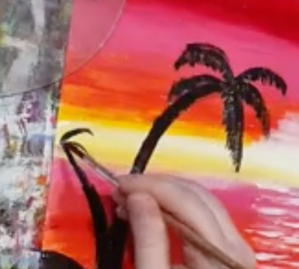
This method is useful for everything from palm trees to pine trees and oak, elm, and… er, just all the sub-types types of greenery out there!
Want to Learn to Paint?
We want to invite you to learn how to paint in both watercolor and acrylic paints with Canvas Academy, your online guide to success as an artist!
With Canvas Academy, you can take 100s of hours of guided classes with videos, printable files, and more. It’s all here and designed to help you become the best painter you can be.
3. Your Thinnest Lines
Create uber-thin lines is, let’s be honest, really hard as a painter. Using a paint brush is already difficult enough since it’s unlike, say, writing with a ballpoint pen. Paint runs and drips easily, and the bristles of a paint brush can warp and move, unlike the tip of a pen.
However, the design of a fan brush actually fights against warping on the bristles. This is because there is typically a metal or plastic clasp that holds the bristles into a distinct “fan” shape, making the bristles less likely to move around compared to other brushes. You can use this to your advantage, then, by using just the tips of the fan brush in areas of a painting where you need to create thin, very controlled lines.
The best way to get thin lines with a fan brush is actually turning the brush on its side and using the side of the bristles (unlike using the brush in its fan shape). Because the brush is flattened into a fan shape, the sideways view of the brush is quite thin, so it makes for a perfect tool for drawing thin lines in paint.
4. Super Symmetrical Circles
Fan brushes are great for another thing–creating precise circles!
You can create circles with this brush by using it almost like a protractor. You know, that thing that always say in boxes at the back of your grade school mathematics classes with the pencil on one end and a metal prick on the other end.
To make a circle with your fan brush, hold one end against the page or canvas, then twirl the other end around in a circular motion, twisting it around that center point. You can then fill in the splotchy circle that results, or leave it in its roughly painted state.

5. Classical Paint Splatters
Creating paint splatters is actually a lot of fun… and you can do it with any type of brush. However, using the fan brush to make them just adds a little extra finesse.
To make paint splatters, hold your fan brush in one hand (probably your less dominate one), just lightly by its base end. Then, using two fingers of your other hand, start tapping the brush somewhere just underneath the bristles. Keep repeating the tapping until you see a good amount of splatters on the page underneath.
Using a fan brush is great for splatters because it really creates a variety of splatter textures. It will leave some “stringy” splatters and some “dotted” splatters behind, whereas other brushes typically only give you one of these texture types.
Now, take what you’ve learned about that untouched paintbrush in your painting stash, and take it with you into your next painting session. Get creative with it, and experiment with all that the fan brush can provide for you!
Until next time, fellow painter…
–Kari

 Kari Lynn M.