Hey there, fellow reader!
I’m assuming you’re here because you want to start your very own book blog, or maybe you’ve kind-of-sort-of already started one, but you want to learn how to take your blog to the “next level”. In either case, I got you, and we’re going to cover it all here today.
Because Bookstagram trends come and go… but, seriously, having a book blog is always in style. Trust me, fellow readers, trust me!
So, let’s go step-by-step here, covering the basic necessities (how to physically setup a blog website online) to the minor details no one else tells you about (like how often you should post to your blog, among so many other things).
Video: So You Wanna Start a Book Blog?
Feel free to watch this video on starting your bookish blog, or scroll down to read everything step by step!
First, Setup Your Blog
You can’t really be a blogger without having an actual blog. Yep, that’s how it works. So, let’s get you going by figuring out the best way for you to setup your first blog!
1. Choose a Website Host/Provider
If you’ve never created a website before… well, some of the words I’m about to use may sound scary, but don’t fret. It’s actually simpler than ever these days to create your own website, and you don’t need to do any real “developing” if you don’t want to!
Doing a quick Google search will bring up a slew and a half of website hosts, but some of the best (just in my opinion) for blogging include:
*I personally use WordPress and have for my own website since, like, the beginning of time (not really, but it’s been over 10 years, so it feels like it!). So, for the rest of this article, I’ll be showing you examples from my own account through WordPress.
Once you pick a website provider, you’ll probably need to make an account (as we do with everything these days, right?), and then, boom, you’re already on your way.
2. Pick a Website (Branding) Name
Now, because everyone and their brother can go ahead and make their own book blog… well, you need to find a way to make your blog special and to make it stand out. One of the best ways to do this is by creating a “brand” for yourself!
This takes some creativity, but you need to create a website domain name anyway (like “www.insertblognamehere.com”), so come up with a really good one! Really, anything works, so long as it’s not already taken.
Think about what you eventually want to put on your blog. Sure, you’ll want to probably write about and post pictures of your favorite books… but what else? Do you want to post pictures of your favorite books in a stack with your cat sitting on top of them? Do you want to specialize in reviews about sci-fi romance novels?
Once you figure out what is going to make your blog stand out from the crowd, use that thing in your blog name. Like “www.BooksAndCats.com”. Or “www.TheSciFiReviewer.com”. It doesn’t have to be long and complicated—simple is always better.
3. Design Your Blog Site
Now… yeah, this part is going to take probably the longest of any step on this whole list, but it’s so important.
The internet is inherently very visual, so having an eye-catching website design is everything, especially these days where people could easily pass up your blog for another. That’s why, again, it’s great to go with a website provider that offers website templates that you can very easily edit to your own taste.

It may take some playing around to understand how to edit the website template you pick, but, again, trust me—it’ll be so worth it. You should be able to change everything from the font (we all love fonts, don’t we?) to the colors of your website—all options you should pick to complement your “brand” that you already decided on.
For example, a blog about cats and books might have cheery colors and use fonts that look handwritten. On the other hand, a blog about sci-fi reviews might have a dark background and solid, block fonts that make a statement.
When in doubt, just take a look at the book cover of your all-time favorite book, and use its colors and fonts as inspiration. There! Now, doesn’t that make things simple?


My author website was originally designed based on the cover of one of my first books, pictured here. Notice how my site uses the same purple hues and simple (sans serif) fonts—all part of my personal branding.
4. Create Some Basic Webpages
Sure, you’ve heard of webpages, but you may not know exactly what a webpage is, or at least how to describe it in words. Don’t worry—just know that a webpage is a single “page” of web content, just like this one you’re reading right now. If you hit the “back” button on your browser, you’ll be on a completely different webpage. Click a link on the page, like this random one, and you’ll be taken to another different webpage.
So, before you actually start blogging, it helps to have a few basic webpages in place to really give your website a good start. The number of webpages you create and add to your website can be basically infinite, too, but let’s keep it easy and just create these to start:
- A “home” page
- An “about” page
- A blog reel page
- A contact page
Of course, some of these pages can be optional for you, for example, if you just plain don’t want anybody to contact you. And that’s fine!
Just keep in mind that the more pages (and useful pages at that, not just “test” pages or anything) you add to your bookish website, the easier it’ll be to get website visitors later on (as we’ll go over below, too, don’t worry). So, add as many pages full of content to your site now, and remember that you can (and probably will, let’s be honest) come back later and add extras like a “top book picks” page, or a “TBR” page, or even a page just dedicated to all your social media links.
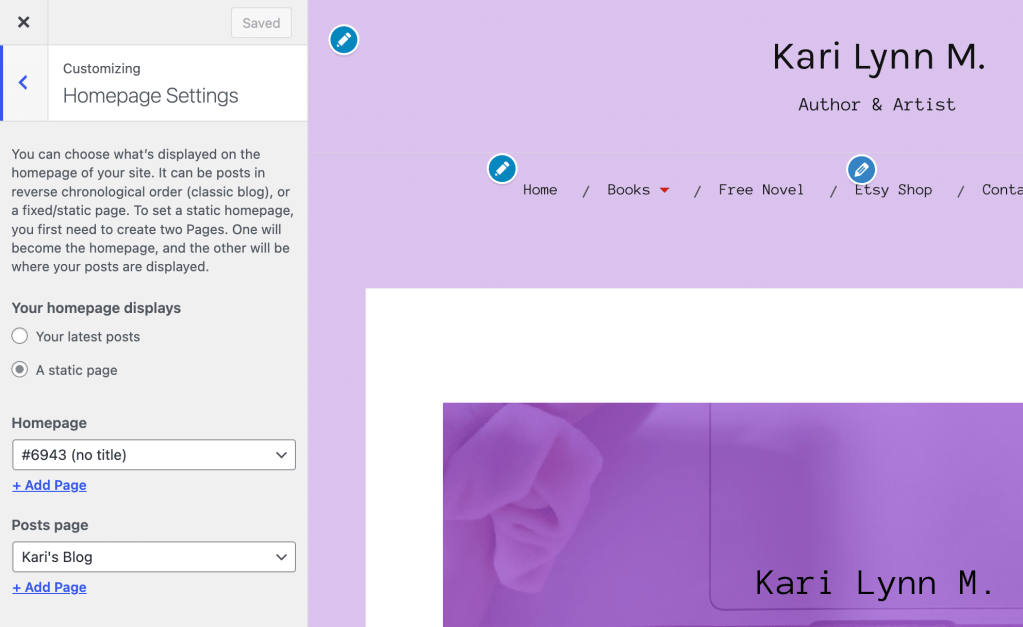
So, to get started creating book blog pages, use your website builder (this varies greatly by provider, but see my example below for WordPress users) and get creative as you add writing, images, and maybe even videos to your essential pages.

Here’s an example of me editing my own “About” page on my books & art website. See how I use the same purple tones and clean fonts, plus I feature images and videos beside text that I actually wrote myself. See the full page as inspiration for your own “about” page here.

Coming up with content to put on your “home” page can be difficult, but I find it very helpful to look at other book blogs and see what others do—that way you can draw inspiration from them. In some cases, you may be able to just set your “home” page as a basic blog reel.
Second, Start Blogging
After you’ve put all the pieces of your book website in place… yay; it’s time to finally start blogging!
It can take a while to get your blog all up and going, so be proud of yourself for making it to this point. Really!
And then the fun begins…
5. Make Your First Blog Post
Say hello to the world of readers with your very first book blog post! This is an exciting time for you, so take a moment to type up a great introduction to yourself and what your future hopes for your blog is.
Seriously, just let your typing fingers do the work and unload your thoughts in your first blog post. Don’t worry about who or how many people will read it—it’s very important to get comfortable as you first start blogging.
Hey, you may even look back on your very first blog post in 10 years and laugh about it. It may seem like the most random thing you’ve ever written in your life. But it doesn’t matter, because your first post is going to make you happy—and that’s what matters.
And, just for the fun of it, here’s my very first blog post. Again… maybe a bit of inspiration for you. Just maybe…
6. Start Writing More Blog Posts (with Organization)
Maybe it’s just because I’m an organization freak, but I truly believe the best bloggers do their best to categorize their blog posts. Even if the categories themselves seem a bit disorganized, it’s always best to have them rather than not.
As a book blogger, here are some categories you may try using for your posts:
- Book reviews
- Book release announcements
- Weekly/monthly reading updates
- Book store/library hauls
- TBR list updates
In WordPress, it’s easy to put posts into categories, almost like putting them neatly into neat little folders. So neat!

Remember how we discussed the idea of coming back around to make more webpages later on in your blogging journey? Well, one of those times could be now, because making webpages for each of your blog categories is a great idea. Just saying.
Perhaps coming up with more blog categories will inspire more blog post ideas for you, and the more blog posts you write, the more categories you will come up with. We love organization!
7. Share Your Blog on Socials
Now, this is totally optional, but it never hurts to share your blog posts directly to your social media channels as you publish them. Plus, some website builders come with features to share posts for you, which makes it even easier on your part.

Want to dive deeper into the world of “Bookish” social media? Check out this free ebook Guide to Bookstagram & BookTok!

Sharing your posts is only going to get you more readers, which is (hint hint) what our next and final section is all about.
Lastly, Evolve and Get Readers
Listen, my blog/website is nothing like it was when I first started (again, nearly 10 years ago). I guarantee that all bloggers find this to be true, and you, dear reader, will be no exception!
A blog is a wonderful thing because it can and does evolve with you. Because we, as people, are always changing, and that’s a good thing!
Along the way in your blogging journey, you’re going to learn and experience so many new things. And, actually, a lot of these things are going to allow you to gain more and more blog readers, which is another plus.
8. To Get Readers, Write for Readers
Okay, here’s where you’re going to need to make a very important choice in deciding what type of path you want your blog to take. I know, it seems scary… but, trust me, this is important.
So, here goes.
You need to decide whether you want a lot of readers or not a lot of readers.
I know, confusing statement. Let’s break it down a little more.
When you think about other people (mostly of whom you don’t know) reading your book blog… how do you feel?
That might make you anxious, and that’s okay—that’s a normal human reaction. However… think about it again, and discover whether your anxiety is rooted more in actual fear or, rather, excitement.
If the thought of a lot of people reading what you write on your blog really does scare you, then your blog might want to take a more personal route. And know that this is 100 and ten percent a-okay! You don’t have to work for more and more blog readers—you can always just write what you want to make yourself happy, and there is never anything wrong with that.
Alternatively, if you find even just a bit of a tinge of excitement in the idea of a lot of people reading your blog… then I’d like to invite you to come down the more reader-focused route. Because you are probably someone who would love to have more views on your website, but you just can’t quite figure out how to get there.
So, if that happens to be you, here’s my absolute biggest piece of advice I can ever bestow: to get more readers, write for those readers.
I know, again, a lot to unpack in that statement. But this is something I started doing when I made the switch from a “personal” blog (again, never anything wrong with that route, too!) to a blog that I wanted to attract a lot of new readers with. Because I learned, as my blog evolved, that internet readers don’t usually want to read a 10,000-word story about how my 90s-era TV set finally broke down on me in the middle of a Barbie movie marathon. Instead, internet readers want to read about things that have to do, somehow, with themselves.
This means that you might have to switch your writing focus in your blog posts from writing about yourself to writing for your readers. And this switch can be very simple, actually—for example, instead of writing about why you love the “Twilight” book series, try writing about why your readers should love the “Twilight” book series.
You can also think about this concept in terms of other websites you actually like to visit and read from a lot. What do those websites offer to you? Don’t you find yourself much more likely to click on the blog post titled “5 Romantasy Books You’ll Be Reading Next” rather than the one titled “5 Romantasy Books I’m Reading Next”?
We as humans are all very self-invested, whether we realize it or not, so getting more readers to your book blog often starts with catering to what your readers want to read.
And, of course, once I made the simple switch from writing about myself to writing for my readers on my website, it took some time, but I very gradually got more and more and more readers. So, it was definitely worth it for me, and it can be for you, too.
9. Always Be Updatin’
Now, as you continue on your little blogging way, remember that it’s never too late in your blogging journey to learn something new. It’s also never too late to change a font on your website if it doesn’t fit right, or even to start recording and adding vlogs (because we all love vlogs, too!) to your blog posts.
Website designs, in general, look very different today than they did in the 1990s. Just take a look back at all the design choices that were made in the beginnings of Barnes & Noble’s website, for example. Wow, times have changed!
Inevitably, website designs are going to evolve and update and look drastically different over the next 10+ years, too. So, never be afraid to make a change!
You may also eventually get bored writing about the same topics over and over and over again, too. It would feel the same to read the same one book over and over and over again. So, try to come up with fresh topics to write about as often as you can—you don’t have to just write book reviews or just write weekly progress updates. Again, see what other book bloggers are blogging about, and try new things.
Above all, remember that blogging is meant to be fun! Fun for both you and your readers—and you should never let it become so stressful that the enjoyment fades.
Keep writing, keep blogging, and keep reading, fellow readers.
–Kari

 Kari Lynn M.