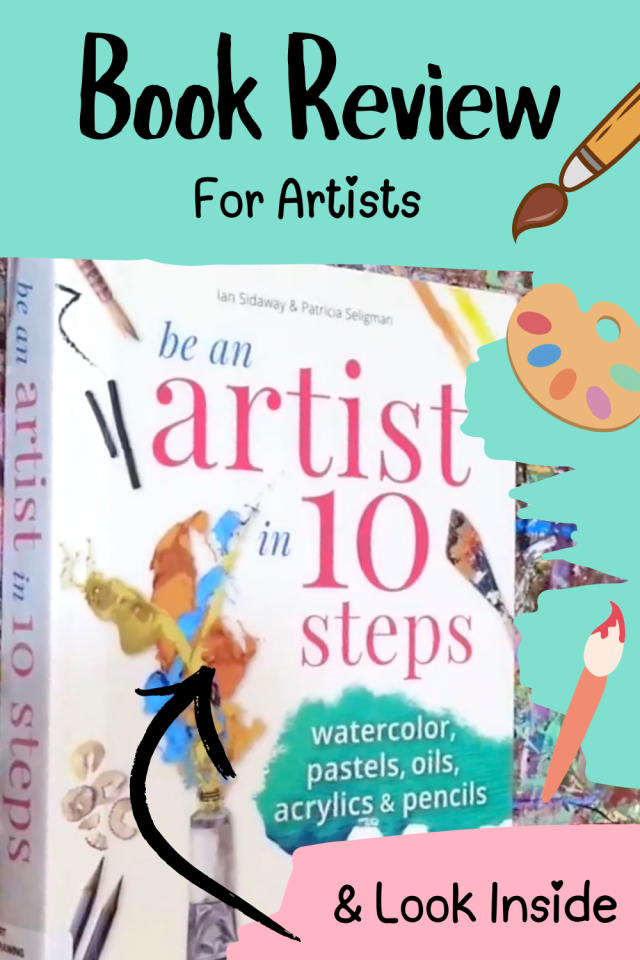
Think you can become an artist in just 10 steps?
Well, we’re going to see… with this peek inside of “Be an Artist in 10 Steps,” a book by Ian Sidaway and Patricia Seligman. We’ll see what the steps to success supposedly are, what kinds of projects are included in the full book, and more.
So, read on for a book review, which I’ll be giving you as a professional artist myself. You can watch my full review in the video below, or you can read on further to see what insights I found in this book—both the helpful and not-so-helpful parts of it.
This is all just meant to help you decide whether looking into this book is really going to be worth it for you as a painter or not. So, let’s see!
Watch the Video Book Review
A Fast Review: “Be an Artist in 10 Steps”
Overall, this book has some good technique tips and simple project ideas. It’s also great for learning how to work in everything from acrylic and watercolor paints to pastels and oils.
Wide Range of Mediums Covered
One thing that this book is great for is learning how to work in a variety of art mediums. This is because there are sections of the book for acrylics, watercolors, oils, pencils, and even pastels.
With so many mediums covered, you’ll be able to experiment with more than just paints and find out what it’s like to work in both “wet” and “dry” mediums. It also never hurts to learn about mediums you don’t particularly like; for example, you may not think you like pastels, but the book gives lots of tips on how to use them in unique ways that you might just enjoy.
Try Step-by-Step Painting Classes Online
Learn to paint in both watercolor and acrylic paints with Canvas Academy, your online guide to success as an artist!
With Canvas Academy, you can take 100s of hours of guided classes with videos, printable files, and more. It’s all here and designed to help you become the best painter you can be.
But There’s Short Coverage of Each Medium
Even though I found that there are a lot of different art mediums included in this book, I also found that, because there are so many covered, the amount of attention given to each medium is quite short. For example, there can only be so many pages covering watercolor techniques when the focus of the book isn’t just on watercolors.
Personally, I would have liked to see more coverage on each of the mediums in-depth, not just skimming the surface, so to say. Because, if you already know a bit about acrylic painting, then you’ll probably not learn much from the section of the book on acrylic painting since it’s quite vague.
And There Are Some Good Project Ideas
There are quite a few good ideas for projects you can create in this book, which I do appreciate!
Putting things you learn about the world of art, including everything from color theory to brushstroke techniques, into practice is super-duper important. Because practice makes your brain remember what you’ve learned, and practicing with quick projects is the perfect way to make that happen. So, this book includes at least a couple of different project ideas in each section, giving you ways to make art in so many ways.
If you’d like to read more of my book reviews, click here. You can hear my firsthand accounts of what some of these books do or don’t do well, and then you can decide if any of them are worth checking out for yourself, espeically when it comes to art-themed books like this one.
Happy painting!
–Kari