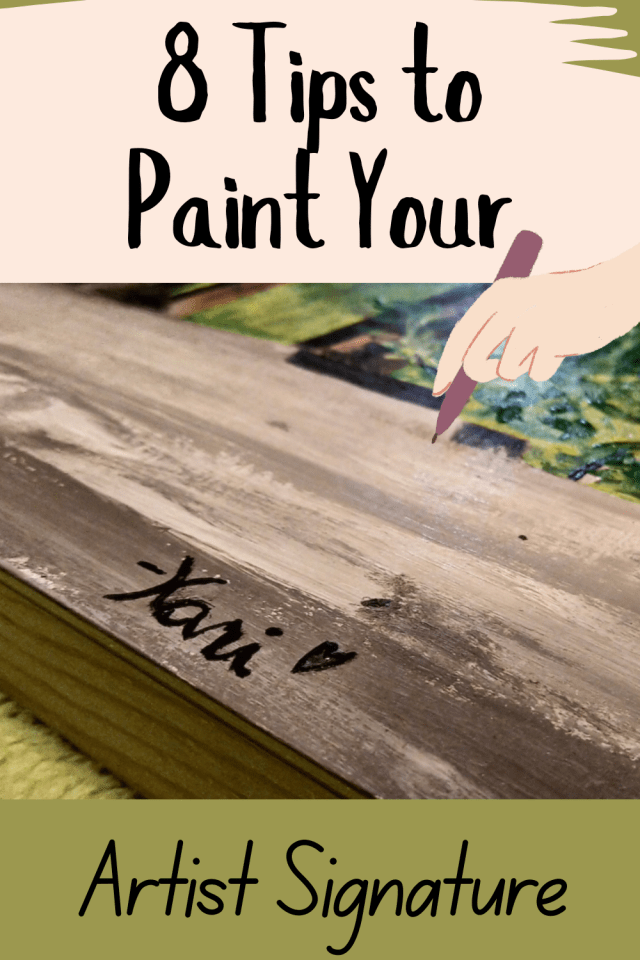
Have you ever wanted to paint the perfect artist signature on every of your finished paintings, but not sure how to actually do it?
No worries, fellow artist, because I’ve got 8 tips to share with you on making your signature stand out. Aside from just practice that is—I’m talking real tips that will actually help you.
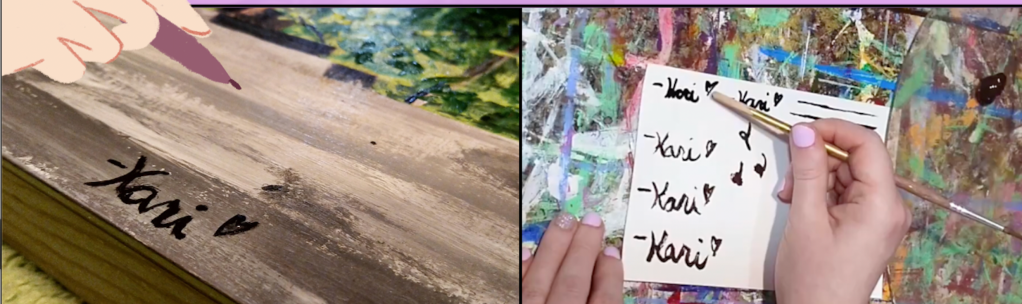
Video: 8 Tips to Make Your Signature Stand Out
Feel free to watch this full, in-depth video on the top 8 tips to make your own artist signature. Or, you can scroll down and read more on each tip.
1. Decide on Your Artist Name
Before you can start putting your artist signature on your paintings… well, you need to figure out what your signature should be and how you want to paint it. For example, do you want to use your full name, your first name only, your last name only, or even a nickname?
You should also think about what style you want to paint in—think of the “font”. Do you want to use cursive or print, and do you want to add symbols, like a dainty heart?
2. Practice in Pen or Marker
Once you’ve decided on a signature, you can start practicing it in pen or marker. This will make it easier for you to visualize how it’s going to look without messing with paints just yet. Pens and markers are actually much easier to write with than brushes, so take advantage of that!
3. Practice Making Thin Lines in Paint
It can be very difficult to make thin lines or curves with a paint brush, and you’ll probably want the lines and curves of your signature to seem neat and thin, so it helps to practice making thin lines.
You can do this by just making lines over and over again on a scrap piece of paper, but focus on keeping each line even thinner than the last. Remember that you won’t want bulky, illegible lines in your signature, so try your best to make your lines as thin as possible, and remember how you made them thin so you can replicate them later with your signature.
4. Choose the Right Brush
The brush you choose makes a big difference when you’re making your signature. The best brush type to use is a small to medium roundhead brush, not a flathead or other type of wide brush.
Keep in mind that smaller is not always better, too, because brushes that are too small and thin on the head will be difficult to “flow” across the page or canvas. Instead, opt for a brush that has a lot of bristles on the head but comes to a fine point on the end.
5. Wet and Twirl Your Brush
Sometimes, even your most trusty roundhead brush will fray and not come to a fine point on the tip. That can happen after using it frequently, but there is a way to ensure it stays pointed on the end.
To do this, you can wet your brush in water, then, holding its bristles parallel to a towel or napkin, gently twirl it around and around. This circular twirling, as the brush is still wet, will help maintain a pointed tip.
6. Hold the Brush Gently
As you start making your signature (finally, right?), make sure you’re not gripping your brush. Instead, you’ll want to hold it very lightly, letting the brush’s head glide across the canvas. This will also help you make your signature neat and tight.
7. Think of it as Painting, Not Writing
One of the top mistakes painters make when making their artist signature is thinking that they are just writing with a paint brush. And this isn’t true—you can’t maneuver a brush across a piece of paper in the same way you can with a pencil!
Instead, you have to remember that you are painting your signature onto your painting. This means that you may have to do things a little differently than you would when you are simply writing. For example, you might have to pause and dip back into your paint multiple times or make some lines and curves from right to left instead of left to right.
8. Use White Paint as “White-Out”
If you happen to “mess up” your artist signature… don’t fret!
You can always paint over your signature, or part of it, and redo it. If your signature is on a white background, just use white paint to cover it up (acrylic works best for this), wait for it to dry, and then paint over it, just like “white out” products.
If you are painting on a background aside from white, just paint over your signature with whatever color is behind it, then allow it to dry and paint your signature over it once again—it should work the same as with white paint on a white background, but it may be tricky if you can’t remember what color you used in the background to begin with.
Now, go on and practice that signature, fellow artist.
–Kari